
Lenore Myers - The Triangular Field (1955)

Beyond the hedgerow, just
a scritch, barely human
form, so close to being
landscapey themselves—
two triangles away from serious
grazing sheep, indistinct
as growing grass. Waving
in the solemn green, a blue
someone hailing from
the larger field—calling
another someone—
we’ll never know what
or if they heard. The horse
is grazing comfortably within
the reassuring geometries,
these green, orderly lanes
of light and land. Across
the golden field, aglow
in summer’s lengthening, an
apple tree seems to leap
into the light, screaming
beneath her bouffant of leaves—
isn’t it usual to see
something a bit wrong?
But leaping is unfolding
life, its anxious squiggles,
in plain sight—here it is
only seeming, and horses,
undisturbed, lack perspective.
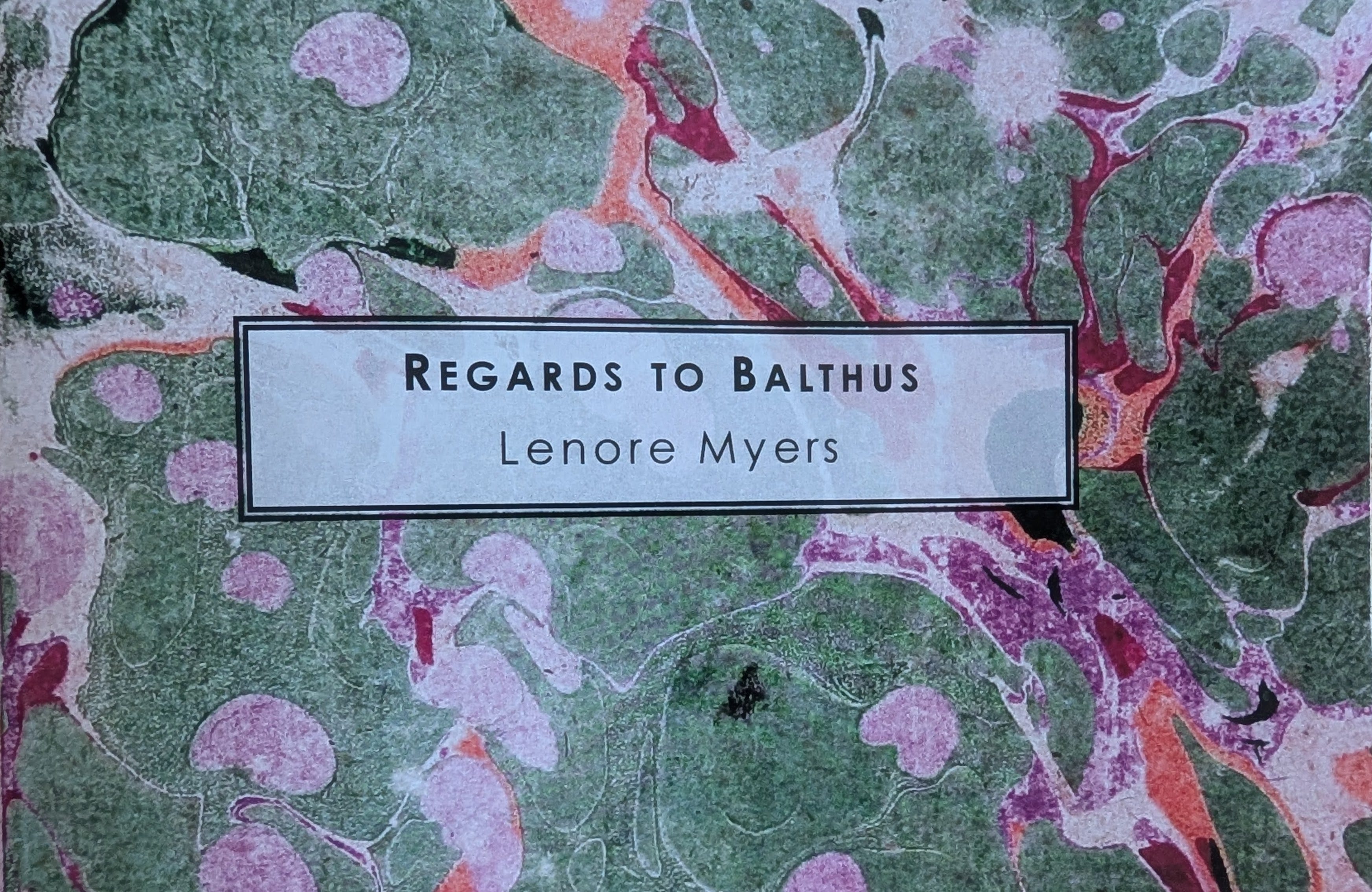
I used to actively seek out the chapbooks of poets whose work I’d come across online. I don’t know exactly when I stopped but I should probably start back up. If you feel like starting as well, Lenore Myers outstanding Regards to Balthus can be purchased directly from the press here. It took a couple of months to come, but it is a small press so that sort of thing is to be expected.
I read this poem in between moments of getting lost looking at my snow covered backyard. We’ve had more snow here in NYC than we’ve had in a few years and I’ve been getting some satisfaction out of noting the slow recession of white against the bark of the eastern hemlock back there. We had a stretch of cold that kept the retreat super slow, so it was a fun game with myself to see if I could spot the difference. This undoubtedly contributed to my interest in this poem over the last week as the sun finally gets to work on a quicker removal.
There is a specific kind of lie that we rely on landscapes for. We need them to be static and reliable, a “reassuring geometry” of green lanes and grazing animals that stays put while we try to figure out our own messy lives. It’s why I used to go and sit by the Hudson river to stare across at the palisades. They were always there regardless of anything else going on. Of course, this is nonsense. Nature isn’t still, it just operates at a different scale and we’re too self-centered to notice.
Myers’ piece feels like it is poking at the friction hiding beneath the illusion of perpetuity. It starts with a sound that physically allows you to feel the friction in your throat. “just/ a scritch, barely human/ form.” Scritch is full fricative texture and is unusual enough that you drag across it as you read it aloud. It provides this living sound of something abrasive rubbing against the silence. But look at the architecture of that first couplet to get an idea of the brilliance of this set up. You’ve got a pair of alliterative brackets, "Beyond the hedgerow” and “barely human,” that create this balanced, rhythmic expectation. It’s a sonic trap. The symmetry of those b’s and h’s lures the ear into a sense of order, emphasizing the disruption that comes with the scritch. It’s worth noting that a scritch is the sound of a scratch, and this is an ekphrastic piece. Myers has literally translated the visual into the auditory across the mediums.
Then there is the structural cleverness. The second and third lines end on human and being, respectively. They line up vertically, hiding a "human being" in the very form of the poem itself. This works as a sort of a physical manifestation of the subject becoming "landscapey." Another bit of clever wordplay gives motion to both the grass and the person through the enjambment of the action so that it attaches to both nouns. This becomes a shared swaying that makes the humans further indistinguishable in the "solemn green."
There are so many instances of sound play through this piece that I ended up running out of unique ways to circle them on the page. I’ll give you one other so you can try to spot more on your own. Myers performs a bit of sonic alchemy towards the center of the poem in the line “or if they heard. The horse” Say it out loud. The word horse essentially swallows the sounds of ‘or’ and ‘heard’, blending the uncertainty of the previous thought into a single, concrete noun. It’s a hell of a move. That’s not even mentioning that she used a couple of anapests to pull it off, which have a sort of galloping sound in bah-bah-BUM.
The center of the poem is loaded with sounds that should, by all rights, feel like a mouthful. “grazing comfortably within the reassuring geometries.” These are heavier words that draw attention out in the comparatively syllable heavy lines. But because of the balance she achieves, they just roll off the tongue. It leads directly into a sequence that flows like water: “orderly lanes of light and land.” The liquid l sounds tie the next lines together into a single, airy breath. “Across/ the golden field, aglow/ in summer’s lengthening, an/ apple tree seems to leap/ into the light” You’ll undoubtedly spot the vowel sounds that are tying that sequence together as well, but it’s the l’s that provide anchors for those vowels.
That sequence also provides us with the hinge. The apple tree doesn’t just grow; it “seems to leap / into the light, screaming / beneath her bouffant of leaves.” That image is fucking terrifying and absurd at the same time. It’s this explosion of action in a pastoral calm. You’ve got the long, pulling vowels of “leap” and “scream” forcing your mouth open, only to be hit with the heavy, plosive thud of bouffant. A ridiculous word that brings to mind the courtly pomp of French kings and the repressed rage of 1960s housewives. Fittingly, Myers uses it to describe a weight of leaves that is effectively suffocating a scream. This sudden burst of emotion is a glitch in the matrix of the poem, and she immediately calls attention to it. “isn’t it usual to see/ something a bit wrong?” It’s an admission that our "orderly lanes" are just a performance. Acknowledgement that the serenity we hang on our walls actually hides complexity and immense tension beneath it.
The speaker argues that "leaping is unfolding / life" and that the "nervous squiggles" are the only things that are actually real. The horse isn't at peace, it just lacks the perspective to see the truth so clear to the screaming tree.
A late edit: My wife, who works in cardiology, is taking part in the American Heart Association’s Go Red For Women fundraiser. She is very passionate about working to correct the severe gender inequality present in medical research, particularly in terms of heart health. I meant to include the link in the intro to this post but got lost in the whole landscape bit. If you’re interested in donating, even just a couple of dollars, the link is here. Thanks.
Dear Mike, Thank you for your perceptive comments! I enjoyed writing this one and I hope you enjoyed reading it, as well. Yes, the stories we tell ourselves...
This poem and others will be in a book coming out this April from Sixteen Rivers Press.